E-Bike or E-Moto? New Laws Draw the Line. Here's How to Tell Before You Buy.
California and Washington now say a bike that tops 20 mph on the motor, or unlocks to go faster, isn't an e-bike. What changed, and how to check before you buy.
· 15 min read
In this article
- E-bike vs. e-moto: the quick answer
- Is this bike actually an e-bike? Check it in 30 seconds
- What changed in 2026
- What makes something an e-bike
- What makes something an e-moto
- Why lawmakers are acting now
- California’s new laws, in plain English
- Washington’s new law
- The federal battery rule: where it stands
- Before you buy: an 8-point screening checklist for US buyers
- If you already own one
- Frequently asked questions
- Sources
If you’re shopping for an e-bike this holiday season, especially for a teenager, the word “e-bike” on the box no longer settles anything. Many of the fastest-selling “e-bikes” online are really e-motos: electric motorbikes with pedals bolted on, or with an “off-road mode” that lets them go far faster than a bicycle is allowed to.
E-bike vs. e-moto: the quick answer
In US states that use the three-class system, a legal e-bike has working pedals, a motor within the state’s power limit (no more than 750 watts in most of these states), and motor assistance that cuts off at its class speed limit: 20 mph for Class 1 and 2, and 28 mph of pedal assist for Class 3.
An e-moto is a more powerful electric two-wheeler that may look like a bicycle but falls outside those requirements. Depending on the state and the vehicle, it may need to be treated as a moped, motorcycle or off-road vehicle, or it may not qualify for road use at all.
Watch for three red flags: high speed on motor power alone, motor power beyond legal limits, and settings that unlock restricted performance.
US-focused summary. Your state’s vehicle definitions and local riding rules still apply.
E-bike vs. e-moto at a glance
| Feature | Legal US e-bike* | E-moto |
|---|---|---|
| Working pedals | Required | May or may not have them |
| Motor power | Generally up to 750 W (federal definition: under 750 W) | May exceed e-bike limits |
| Motor assistance | Cuts off at 20 or 28 mph, depending on class | May keep going above e-bike limits |
| Throttle | Class 2 only (Class 1 and 3 may have a walk mode up to 3.7 mph) | Common, but varies |
| Bike lanes and paths | Depends on class and local rules | Generally not allowed as a bicycle |
| Registration | Generally not required | May be required to ride on roads, and some can’t be registered at all |
| Driver’s license | Generally not required | Depends on how the vehicle is classified |
| Intended use | Cycling, commuting, recreation | Off-road riding, or road use only where it qualifies as a motor vehicle |
*Applies to the common US three-class state frameworks. “E-moto” is a descriptive term, not a uniform legal vehicle category.
The difference matters after you buy, too: being able to buy an e-moto doesn’t mean you can legally ride it on public roads, bike lanes or trails.
Is this bike actually an e-bike? Check it in 30 seconds
Answer six questions from the listing or the bike’s label. The checker runs in your browser; nothing you enter is sent anywhere.
Is this bike actually an e-bike?
0/6 answeredUS three-class screening. Not a legal determination.
Answer all six questions to see the result.
Based on the federal definition (15 U.S.C. § 2085) and the three-class state frameworks, including California’s and Washington’s 2026 rules. Your state’s definitions and local riding rules still apply.
What changed in 2026
Lawmakers have noticed the e-moto problem. On September 30, 2026, California’s governor signed SB 1167, which redraws the line between e-bikes, mopeds and electric motorcycles and goes after sellers who blur it. Washington’s ESSB 6110, in force since June 11, 2026, does much the same. And a federal safety rule for e-bike batteries is moving through the Consumer Product Safety Commission (CPSC).
Here’s what changed, what still applies everywhere, and a checklist to tell a real e-bike from an e-moto before you pay.
What makes something an e-bike
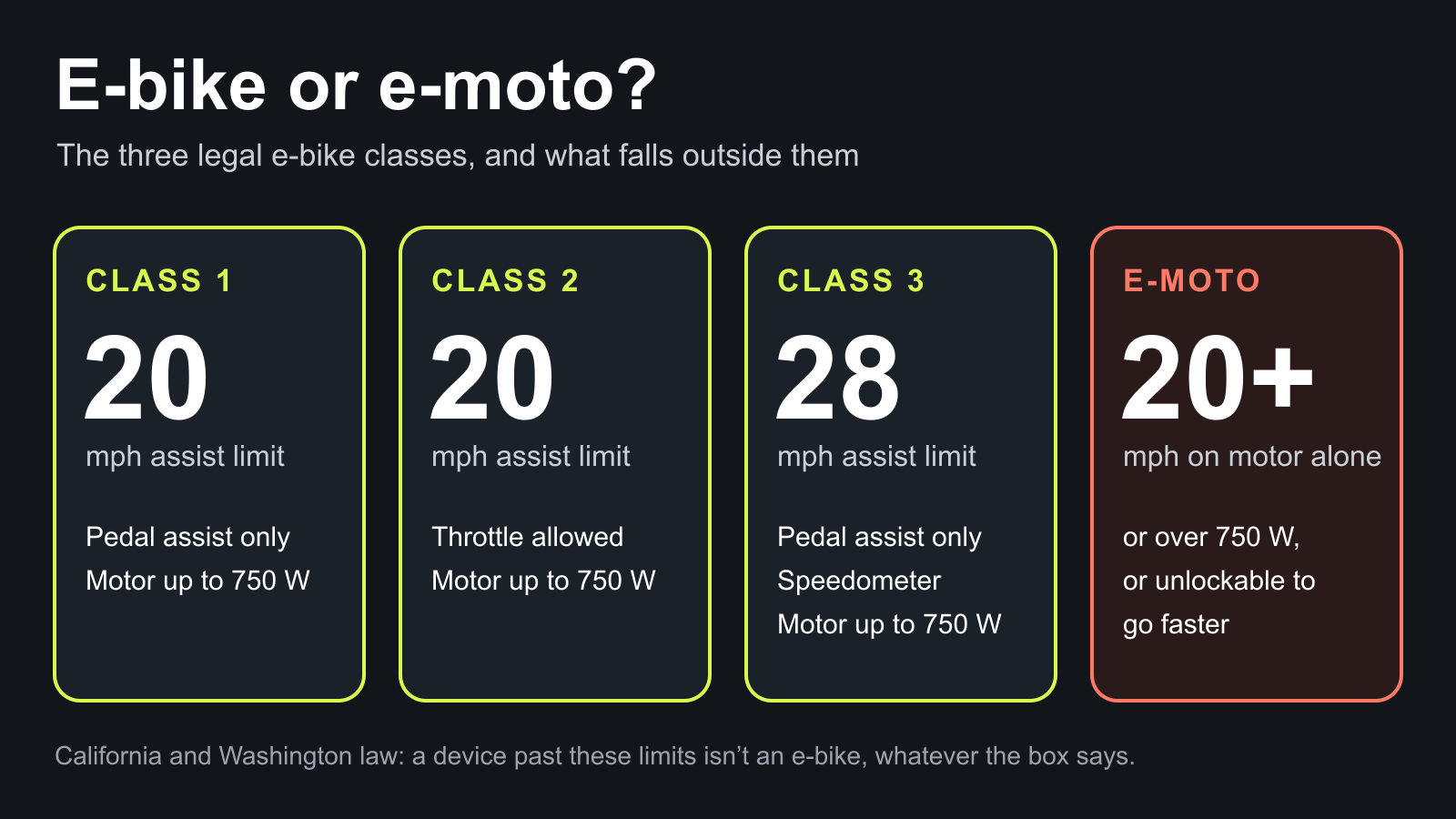
Many US states use the same three-class system, and California’s definition, updated by SB 1167, is a clear example of it. An e-bike must have fully operable pedals and a motor of no more than 750 watts, and it must fit one of three classes:
| Class | How the motor helps | Motor stops helping at |
|---|---|---|
| Class 1 | Only while you pedal | 20 mph |
| Class 2 | Pedaling or a throttle | 20 mph |
| Class 3 | Only while you pedal (and it must have a speedometer) | 28 mph |
Class 1 and 3 bikes may also have a walk mode or start assist that moves the bike on motor power alone, but only up to 3.7 mph.
Ads often mix up three different speeds, so it helps to keep them apart:
- Motor-only (throttle) speed: how fast the motor moves the bike with no pedaling. Class 2 throttles must stop at 20 mph. Class 1 and 3 bikes have no throttle beyond a 3.7 mph walk mode.
- Pedal-assist speed: the speed at which the motor stops helping while you pedal: 20 mph for Class 1 and 2, 28 mph for Class 3.
- Pedaled speed: how fast you can go under your own power, for example downhill. No class limits this; above the cutoff, the motor simply stops helping.
The federal government has its own, simpler definition. A “low-speed electric bicycle” has fully operable pedals, a motor of less than 750 watts, and a top speed under 20 mph on motor power alone with a 170 lb rider. Note the small difference: the federal law says less than 750 watts, while three-class state laws such as California’s allow no more than 750 watts. The federal definition decides which federal product-safety rules apply. Where and how you can ride is set by your state.
What makes something an e-moto
“E-moto” isn’t a legal category. It’s the name for electric motorbikes that are sold, and often ridden, as if they were bicycles. California’s new law spells out what is not an e-bike and can’t be advertised, sold or labeled as one:
- a vehicle with a motor of more than 750 watts
- a vehicle that can go faster than 20 mph on motor power alone
- a vehicle whose motor keeps assisting above 28 mph
- a vehicle the manufacturer intends to be modifiable to do any of the above
- a vehicle without operable pedals
- any motorcycle, moped, motorized scooter, pocket bike or off-highway electric motorcycle
The fourth point is the big one. An “unlimited” or “off-road” mode, a hidden switch, or an app setting that removes the speed limit now disqualifies a bike in California even if it ships in a legal setting. Washington’s law says the same thing in plainer words: a vehicle that is “designed, manufactured, or intended by the manufacturer or seller to be easily configured” to exceed e-bike limits isn’t an e-bike, “whether by a mechanical switch or button, by changing a setting in software controlling the drive system, by use of an online application, or through other means.”
Why lawmakers are acting now
California legislators wrote their reasons into the bill. They found that e-motos are “designed and marketed as ‘e-bikes’ to children on social media,” and that nearly 90% of the electric devices seen at school bike racks in San Mateo and Marin counties in 2025 were e-motos, not e-bikes. They also cited a 2025 report from San Jose State University’s Mineta Transportation Institute, which, as CalMatters reported, found that illegal e-motos, not legal e-bikes, are the main reason behind rising injuries among electric mobility riders.
Crash numbers are climbing too. CalMatters reported that UC San Diego researchers counted 2 e-bike collisions in California in 2018 and 1,566 in 2024, with riders aged 14 and under a fast-growing share, although far more people ride e-bikes now than in 2018.
California’s new laws, in plain English
Governor Newsom signed three e-bike laws this fall. Like most new California laws, they generally take effect on January 1, 2027, though some parts start later.
SB 1167: the e-moto law
- No more “e-bike” labels on e-motos. The list of vehicles that can’t be advertised, sold or labeled as e-bikes grows to cover mopeds, motor-driven cycles and anything built to be unlocked past e-bike limits.
- New definitions for electric mopeds and motorcycles. A moped now means a device with a motor under 3,000 watts that tops out at 30 mph. A motor-driven cycle can have an electric motor of up to 3,750 watts. Both must be designed for highway use, meet federal motor vehicle safety standards, carry a 17-digit VIN and a safety certification label, and meet the Vehicle Code’s equipment rules. Most e-motos sold online as “e-bikes” have none of that.
- Honest ads. Anyone who makes, imports or sells an electric moped, motor-driven cycle or off-highway electric motorcycle must include a specified disclosure in all advertising, including online stores and social media.
- Better e-bike labels. E-bikes already have to carry a permanent label showing their class, top assisted speed and motor wattage. SB 1167 adds the brand name and the manufacturer, importer or distributor.
- No mail-order class stickers. E-bike classification labels can only be sold and installed by a physical retailer or bike repair shop, which must check that the label matches the bike.
- Riding an e-moto on public roads. It becomes illegal to ride a two- or three-wheeled electric device that can go faster than 20 mph on motor power alone on a road or public right-of-way unless it’s a vehicle type the Vehicle Code authorizes there, and police can remove it.
- Crash reports. Police reports for crashes involving e-bikes, mopeds and motor-driven cycles must record the information on the vehicle’s label, or note that it had none.
AB 2346: lights, speedometers and speed limits
According to CalMatters, from January 1, 2027, cities and counties can set 10 to 20 mph speed limits for e-bikes on bike paths and multi-use trails, and e-bikes get a default 10 mph limit on sidewalks. From January 1, 2029, Class 2 e-bikes must have a speedometer, all e-bikes need front and rear lights (built in or detachable), and retailers must tell buyers each bike’s class, top speed and any age restrictions.
AB 2595: a minimum age in San Mateo County
San Mateo County can run a pilot program that bans children under 12 from riding certain lower-speed e-bikes, with $25 fines for parents or guardians. It ends in 2031. San Diego and Marin counties got similar pilots in 2024. Statewide, California still has no minimum age for most e-bikes, but Class 3 riders must be at least 16.
Washington’s new law
Washington’s ESSB 6110 was signed on March 23, 2026 and took effect on June 11, 2026. It removes from the definition of an e-bike any vehicle that can go faster than 20 mph on motor power alone, and any vehicle built or sold to be easily switched past e-bike limits. Riders under 16 still can’t ride Class 3 e-bikes, new e-bikes must carry a label with their class, top assisted speed and wattage, and anyone who modifies an e-bike’s speed has to relabel it.
The law also tells the Department of Licensing to set up a work group on how e-motos should be registered, licensed and policed. Its interim recommendations are due on December 15, 2026, and its final report by October 31, 2027, so expect more changes.
Other states have passed their own e-bike changes in 2026, and the details differ a lot from state to state. Check your state’s DMV or legislature website before you buy, and see our guide to e-bike age limits.
The federal battery rule: where it stands
Separately, the CPSC has proposed a mandatory federal safety standard for lithium-ion batteries in e-bikes, e-scooters, hoverboards and other micromobility products. It would cover the battery, battery management system, charger and other electrical parts, as well as replacement battery packs sold on their own. It builds on existing UL standards, including UL 2849 for e-bike electrical systems, with extra requirements added.
The CPSC says it knows of 227 incidents from 2019 through 2023, including fires, explosions and burns, that the rule could have prevented. Those incidents involved 39 deaths and 181 injuries.
The proposal was published on June 24, 2026, written comments closed on August 24, and the CPSC held a virtual public hearing on October 21. As of November 14, 2026, the Federal Register showed no final rule. If one is adopted, it would apply to products made 180 days or more after it’s published. We explained the proposal in detail in The Federal Government Is About to Regulate Your E-Bike Battery.
California got there first. Since January 1, 2026, any e-bike sold or leased in California must have a battery tested by an accredited lab against a battery standard referenced in UL 2849 or EN 15194, and new e-bikes must show the testing lab’s mark and the standard on the bike, its battery or its electrical system. That marking rule doesn’t apply to secondhand sales.
Those two standards aren’t battery certificates as such. UL 2849 is the North American safety standard for an e-bike’s whole electrical system: battery, charger, motor and controller. EN 15194 is the European standard for electrically power assisted cycles as a whole, which includes battery requirements. A battery-only certification such as UL 2271, which covers batteries for light electric vehicles, is a different thing.
Before you buy: an 8-point screening checklist for US buyers
This is a screening checklist for shoppers in the US, not a legal test. The definitions and riding rules that apply to you are your state’s and city’s. If a bike fails any of these checks, it may not be a legal e-bike where you live, and it isn’t one to buy until the seller can answer your questions.
- Find the class. The listing and the bike itself should say Class 1, 2 or 3. California and Washington require a permanent label with the class, top assisted speed and motor wattage. No class at all is a red flag.
- Check the motor rating. Three-class state laws allow a motor of no more than 750 watts, and the federal definition says less than 750 watts. If a listing leads with 1,000, 1,500 or 2,000+ watts, it’s outside both. If it only lists a “peak” figure, ask the seller for the motor’s rated power.
- Check which top speed the ad means. On motor power alone, a legal e-bike tops out at 20 mph (a Class 2 throttle); Class 1 and 3 bikes have no throttle beyond walk mode. Pedal assist should cut out at 20 mph (Class 1 and 2) or 28 mph (Class 3). You can pedal faster than that yourself, but if an ad promises 30, 40 or 50 mph from the motor, it’s describing an e-moto.
- Look for “unlock” features. “Off-road mode,” “unlimited mode,” “private property mode,” or an app setting that lifts the speed limit all mean the bike is built to be modified, which disqualifies it in California and Washington.
- Look at the pedals. They should be real, working pedals that drive the rear wheel. Foot pegs, or pedals that are too small or awkward to actually pedal with, are a sign you’re looking at a motorbike.
- Look for a battery safety mark. Ask whether the bike’s electrical system is certified to UL 2849 by an accredited lab. A bike built for Europe may cite EN 15194, the EU standard for e-bikes as a whole, instead. Look for the lab’s mark and the standard on the bike, battery or electrical system; in California, a new e-bike must show them.
- Use the charger made for the bike. California law requires chargers to be certified for the bike or battery they’re sold for. Cheap replacement chargers and batteries are where fire risk climbs.
- Buy from a seller who can answer all of this. A good shop will tell you the class, motor rating, top speed and battery certification without hesitating, and keep you legal when it sets the bike up.
Not sure which e-bike fits? Bike Match checks your height, weight and budget against 200+ bikes, and our best electric bikes under $1,000 and best electric bikes for heavy riders guides cover bikes with published specs.
If you already own one
First, find out what it actually is: look for the class label, the motor rating and any speed-unlock setting. If it can go faster than 20 mph on the throttle or has been unlocked, don’t treat it as a bicycle. Depending on your state and the vehicle, it may count as a moped, motor-driven cycle, motorcycle or off-highway vehicle, or it may not fit any road-legal category at all.
In California, from 2027 a device like that can’t legally be ridden on public roads unless it’s a vehicle type the Vehicle Code authorizes there, such as a moped or motor-driven cycle. Under SB 1167 those need a 17-digit VIN, federal safety certification and road equipment, which most e-motos sold as e-bikes don’t have, so many can’t be registered for road use at all. In Washington, it already falls outside the e-bike rules. Check with your DMV before riding it on public roads, bike paths or trails, and don’t let a child ride it as if it were a bicycle.
If your e-bike was modified to go faster, putting the factory settings back undoes that modification, but it doesn’t necessarily make the bike a legal e-bike again. If the bike was built to be unlockable, or its motor is over the power limit, California and Washington still exclude it. Ask the manufacturer which class the bike was certified and labeled as, and whether the unlock can be removed for good. In Washington, anyone who changes an e-bike’s speed capability must also replace its label.
Frequently asked questions
What is the difference between an e-bike and an e-moto?
An e-bike has working pedals, a motor within the legal power limit (no more than 750 watts under three-class state laws; the federal definition says less than 750 watts), and a motor that stops helping at 20 mph (Class 1 and 2) or 28 mph (Class 3 pedal assist). Only Class 2 has a throttle, and it stops at 20 mph. An e-moto is a more powerful electric two-wheeler that may look like a bicycle but goes past those limits: more power, more speed on the motor alone, or a setting that unlocks them. In California and Washington, an e-moto is not legally an e-bike, whatever it’s called when it’s sold.
Is an e-bike with an “off-road mode” legal?
Not as an e-bike in California or Washington. California’s SB 1167 excludes any vehicle the manufacturer intends to be modifiable past e-bike limits, and Washington’s law excludes any vehicle built to be easily switched past them by a button, software setting or app.
When does California’s e-moto law take effect?
SB 1167 was signed on September 30, 2026. Like most new California laws, it generally takes effect on January 1, 2027, although some parts of California’s 2026 e-bike laws start later, such as the 2029 speedometer and lighting requirements in AB 2346.
Do I need a license to ride an e-bike?
Not for a legal Class 1, 2 or 3 e-bike in California or Washington. Devices that fall outside the e-bike rules may be classed as mopeds, motor-driven cycles, motorcycles or off-highway vehicles, which can require registration, a license and a VIN, and some don’t qualify for road use at all. Rules vary by state, so check with your DMV.
How old do you have to be to ride an e-bike?
It depends on the state and the class. In California and Washington, riders of Class 3 e-bikes must be at least 16. California has no statewide minimum age for Class 1 and 2 e-bikes, but some counties, including San Diego, Marin and now San Mateo, have pilot programs with age limits. See our e-bike age guide.
Is there a federal law on e-bike batteries?
Not yet. The CPSC proposed a mandatory safety standard for lithium-ion batteries in e-bikes and other micromobility products on June 24, 2026, but as of November 14, 2026 no final rule had been published. California already requires e-bike batteries sold in the state to be tested against a battery standard referenced in UL 2849 or EN 15194.
What does UL 2849 mean on an e-bike?
UL 2849 is a safety standard for the whole electrical system of an e-bike, including the battery, charger and motor electronics. A UL 2849 certification from an accredited lab means that system was tested for electrical and fire hazards. It’s the standard California law and the CPSC’s proposed rule both point to.
Can I ride an e-moto on a bike path?
Generally not. Bike paths and trails are open to bicycles and, where allowed, legal e-bikes. In California from 2027, a two- or three-wheeled electric device that can exceed 20 mph on motor power alone can’t be ridden on public roads or rights-of-way unless it’s an authorized vehicle type, and local rules on paths and trails can be stricter still.
Sources
- California SB 1167 (Chapter 846, Statutes of 2026), California Legislative Information
- California Health and Safety Code § 26302 (e-bike battery testing, operative January 1, 2026)
- CalMatters: Deadly e-bike crashes shaped 3 new California safety laws (October 9, 2026)
- Washington ESSB 6110 (Chapter 159, Laws of 2026) and its final bill report, Washington State Legislature
- CPSC proposed rule: Safety Standard for Lithium-Ion Batteries Used in Micromobility Products, Federal Register, June 24, 2026, and the October 5, 2026 hearing notice
- 15 U.S.C. § 2085 (federal definition of a low-speed electric bicycle)
Checked on November 14, 2026. This article explains the laws; it isn’t legal advice. E-bike rules differ by state and city, so check your local rules before you ride.
Alek Asaduryan
Alek is the founder of YesCycling and has been riding bikes and in the cycling industry since 1991. Since then, his mission is to make cycling more accessible to everyone.