1974 vs 2026: What Changed on Mount Royal
Fifty-two years ago, Eddy Merckx won a world title on this mountain in 30-degree heat, on a steel bike, in front of 150,000 people. Only 18 of the 70 starters finished. Here’s what’s different when the peloton comes back on 27 September — and what isn’t.
On 25 August 1974, the Road World Championships were held outside Europe for the first time. The venue was Montreal, the circuit went over Mount Royal, and the race turned into one of the hardest post-war editions of the championship.
Bernard Thévenet attacked and rode alone at the front for around 120 kilometres, with a lead that reached two and a half minutes. Merckx assembled a chase group of the strongest men in the race, hunted him down, and caught him with roughly six kilometres left. On the final climb of Mount Royal, Merckx went. Only Raymond Poulidor — then 38 years old — could follow. Merckx out-sprinted him on Boulevard Édouard-Montpetit for his third and final world title, completing the Giro-Tour-Worlds Triple Crown in a season where he also won the Tour de Suisse.
Eighteen of the seventy starters finished. The defending champion, Felice Gimondi, climbed off and watched the finish from the stands.
On 27 September, the rainbow jersey comes back to the same mountain. Here’s the comparison.
The numbers
| 1974 | 2026 | |
|---|---|---|
| Men’s road race | 262.5 km, 21 laps of 12.5 km | 273.7 km, 12 laps of 13.4 km after a 112.4 km approach |
| Women’s road race | 50 km, 4 laps of 12.5 km | 180.4 km, 8 laps after a 72.7 km approach |
| Men’s winning time | 6h 52′ 22″ (about 38.2 km/h) | scheduled 09:00–15:40, roughly 41 km/h |
| Titles decided | 4 | 13 |
| Field | 70 men from 15 nations | around 1,000 riders from roughly 75 nations |
| Men’s finishers | 18 | to be determined |
| Conditions | over 30°C, late August | late September |
| Start/finish | Boulevard Édouard-Montpetit | Avenue du Parc |
Two things jump out. The men’s race is barely longer than it was in 1974 — eleven extra kilometres across 52 years. And the women’s race is more than three and a half times the distance it was.
The bikes: from steel and toe clips to a 65mm rule
The equipment gap is the one most people expect to be enormous, and it is — but not always in the ways you’d guess.
1974. Steel frames, lugged and brazed, built by small workshops. Campagnolo Nuovo Record. Ten gears at most, shifted with friction levers on the down tube, which meant taking a hand off the bars and feeling for the right position mid-climb. Toe clips and leather straps. Tubular tyres glued to the rim, around 20mm wide, pumped hard. Wool jerseys. Complete bikes somewhere around 9 to 10 kilograms. Helmets were optional and most of the peloton, Merckx included, raced bare-headed.
Sponsorship worked differently too. Merckx’s Molteni team went through a rotating cast of frame builders during his time there — Colnago early on, then Kessels from 1973, with De Rosa and Masi in the mix around the same period. Ugo De Rosa had joined Merckx as his mechanic, and during the 1974 Giro an estimated 80% of the peloton was riding frames he had built. A modern team locked into a single brand for a three-year contract would find that arrangement unrecognisable.
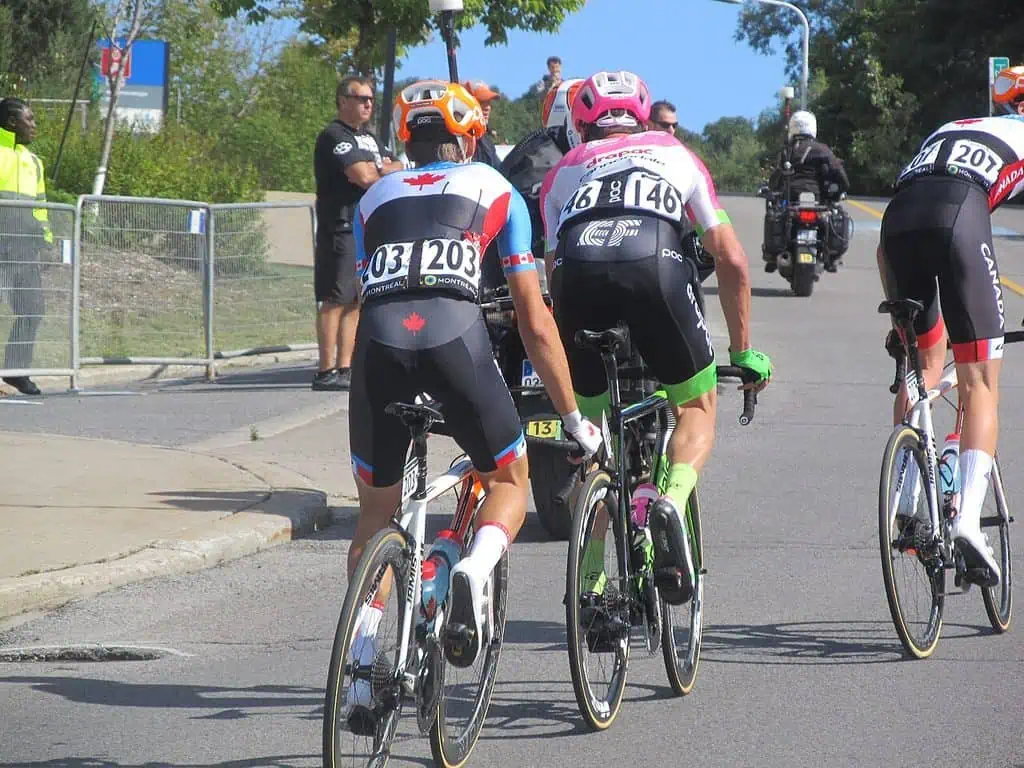
2026. Carbon aero frames sitting close to the UCI’s 6.8 kg minimum weight. Twelve-speed electronic groupsets, most of them wireless. Tubeless tyres at 28 or 30mm on rims around 25mm wide internally, which would have looked like mountain bike equipment in 1974. Power meters in every crankset. Hard-shell helmets, mandatory.
The interesting wrinkle is that the technology curve has started bending back. The UCI has capped rim depth at 65mm, and with a possible hookless ban still hanging over road cycling, wheel manufacturers have hedged by building new rims with hooks or mini-hooks. Meanwhile aero frames have got light enough that riders now stay on them even in the mountains rather than switching to a climbing bike — which is functionally a return to the 1974 situation, where you rode one bike and that was that.
The biggest change isn’t the equipment
It’s the women’s race.
In 1974, the elite women raced 50 kilometres — four laps of the same circuit the men would cover twenty-one times the following day. Geneviève Gambillon won it in a five-rider sprint ahead of Baiba Caune of the Soviet Union, the Netherlands’ Keetie van Oosten-Hage, Britain’s Beryl Burton and Belgium’s Mariette Laenen. It was one race, on one day, and it was the entire women’s programme.
In 2026, the women race 180.4 kilometres with 2,570 metres of climbing, on the same circuit as the men, with more than 2,150 metres of that elevation coming from the eight Mount Royal laps alone. They also contest a time trial, an under-23 road race, an under-23 time trial, a junior road race, a junior time trial, and a mixed relay.
Four titles in 1974; thirteen in 2026. Most of that growth is women’s racing that simply didn’t exist.
What hasn’t changed at all
The format. There are still no trade teams. Riders leave their professional squads and race for their countries, which means teammates become rivals for a week and the tactical logic of the whole season gets thrown out. Merckx had ten Belgians in the 1974 race, of whom only two were his Molteni teammates — and the Belgian squad was split into three factions, one behind Merckx, one behind Freddy Maertens, and a third owing allegiance to neither, largely because of a feud left over from the previous year’s Worlds.
No race radios. Then and now. Riders read the race with their eyes, get information from the chalkboard and the team car, and guess about the rest.
The mountain. Camillien-Houde is still the climb that decides it. In 1974 the circuit had three climbs per lap, including the long ascent through Mount Royal Park known as the Côte du Belvédère and a shorter rise through the university campus. In 2026, riders face Camillien-Houde, the Côte de la Polytechnique with its 11% ramps, and Pagnuelo — the same shape of difficulty, the same absence of recovery, the same accumulation.
The attrition. Nothing about this circuit looks hard once. The 1974 race proved what it does eighteen times; 2026 will test what it does twelve.
The one thing that can’t be repeated
Merckx arrived in Montreal in 1974 having already won the Giro and the Tour that season. He left with the Triple Crown.
The rider who might have done something comparable in 2026 isn’t there. Tadej Pogačar, two-time defending road race world champion, crashed out of the Vuelta and ended his season early. That absence is precisely why this edition is wide open — Remco Evenepoel, Mathieu van der Poel, Wout van Aert, Tom Pidcock, Isaac del Toro and Paul Seixas all arrive with a genuine claim, and none of them arrives as the rider everyone else must organise around.
In 1974 the race had an obvious centre and still took nearly seven hours to resolve. In 2026 it has no centre at all.
When to watch
- Sunday 20 September — elite time trials, 39.2 km
- Saturday 26 September — elite women’s road race, 180.4 km
- Sunday 27 September — elite men’s road race, 273.7 km
All thirteen races finish on Avenue du Parc, and roadside viewing is free.