The Climb That Decides the Worlds
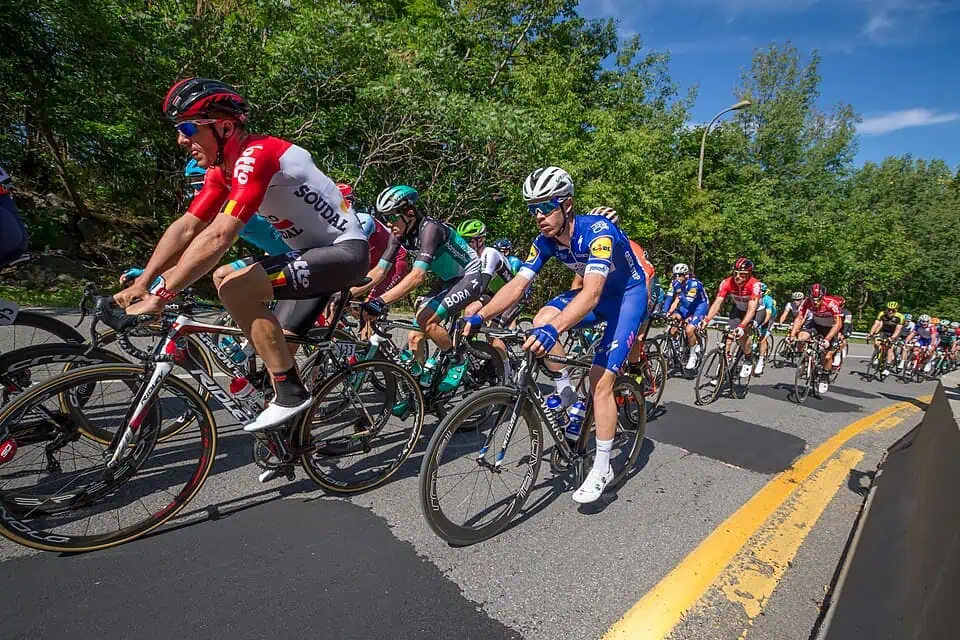
Camillien-Houde is 1.6 kilometres of winding park road that most Montrealers know as a shortcut. On 27 September, the world’s best riders will go up it twelve times, and the last one will settle who wears the rainbow jersey.
Nothing about the Montreal course looks frightening on paper. There is no Alpine pass, no wall of cobbles, no summit finish. What there is instead is a 13.4-kilometre loop around Mount Royal containing roughly 269 metres of climbing, and a start list that has to ride it over and over until somebody cracks.
That is the entire design. One passage of Camillien-Houde is manageable for almost everyone on the start list. Twelve are not.
Nobody agrees how long the climb is
Start with the strangest thing about the defining climb of this World Championships: the numbers change depending on who you ask.
The Worlds organisers list Camillien-Houde at approximately 2.3 kilometres averaging 6.2%. Other route guides put the hardest section at around 1.8 kilometres at 8%. At least one preview measures it at 1.6 kilometres at 7.7%. The City of Montreal, describing the road rather than the race, calls it a winding 1.6-kilometre climb rising about 119 metres toward the summit.
They’re all describing the same hill. The discrepancy comes from where you start the clock — whether you count the shallow approach from Avenue du Parc or only the steepening section past the first hairpin. What matters for the race is the shape rather than the average: a sustained grind long enough that you can’t simply punch over it, at a gradient shallow enough that a strong rider can hold a wheel without exploding.
Which is precisely why it doesn’t decide anything on lap one.
The lap, corner by corner
The 2026 circuit is new. Organisers extended the traditional 12.3-kilometre Mount Royal lap to 13.4 kilometres, pushing the race onto additional Montreal streets while keeping the sequence that has defined the Grand Prix Cycliste de Montréal for fifteen years.
That sequence runs like this:
Avenue du Parc to Camillien-Houde. The road turns uphill almost immediately after the start line. From the second kilometre, riders are climbing towards the Camillien-Houde summit — the hardest ascent of the lap, and the one that shapes everything. It tops out with roughly 11 kilometres left in the circuit.
Côte de la Polytechnique. After the descent comes the second test, around the Université de Montréal. It measures roughly 780 metres at 6%, but the average is a lie: about 200 metres of it rises above 11%. It summits with around 6 kilometres to go, which makes it the best launchpad on the lap for a move that sticks.
Pagnuelo. A final rise of 500 to 600 metres at roughly 7%, arriving with about 3 kilometres remaining. Short, but late enough that a small group getting away here becomes genuinely awkward to chase.
Avenue du Parc. The finish is a rising drag, not a flat sprint. Whatever group survives the circuit still has to contest an uphill kick after hours of climbing.
There is no recovery section. That is the point.
The arithmetic of attrition
The elite men race 273.7 kilometres with 3,803 metres of climbing. The first 112.4 kilometres take the peloton from Brossard through the flatter roads of Montérégie before crossing the Samuel-De Champlain Bridge into the city. From there, twelve laps of Mount Royal account for more than 160 kilometres and almost all of the elevation.
The elite women race 180.4 kilometres with 2,570 metres of climbing, opening with 72.7 kilometres through Brossard, Carignan, Chambly and Richelieu before eight laps of the same circuit. More than 2,150 metres of their total elevation comes from those eight laps alone — meaning the final two-thirds of the race is dramatically harder than the opening profile suggests.
For context, the 2025 women’s race in Kigali packed around 3,350 metres into 164.6 kilometres, a far more vertically concentrated championship. Montreal is the opposite kind of difficulty: less severe, much longer, and cumulative.
The dress rehearsal already happened
Unusually, we’ve seen this circuit raced at full speed two weeks ago. The Grand Prix Cycliste de Montréal on 13 September used the same new 13.4-kilometre lap, 16 times, for 214.4 kilometres and 4,304 metres of climbing.
Isaac del Toro won it, beating Paul Seixas on the exact roads that will decide the rainbow jersey. Tom Pidcock was sixth. A week earlier, Remco Evenepoel had won GP Québec.
What that race demonstrated is the thing television rarely shows: the cost of position. Two riders can climb at identical speeds and still arrive at the finale with completely different reserves, because one spent the afternoon moving smoothly near the front while the other kept accelerating to repair bad positioning. Over twelve laps, that difference compounds into the result. The fight for position before Camillien-Houde matters nearly as much as the climb itself.
The other story of this hill
Camillien-Houde is not a purpose-built race climb. It’s a public road over a public mountain, and Montreal has spent almost a decade arguing about what it should be.
In October 2017, an SUV made an illegal U-turn near the lookout and struck Clément Ouimet, an 18-year-old competitive cyclist descending the road. He died in hospital. Around 250 cyclists rode up the mountain in silence days later. The coroner’s report later found that the layout of the east-facing lookout, accessible to drivers only from the west, effectively encouraged the manoeuvre that killed him.
What followed was years of civic trench warfare. The city ran a five-month pilot in 2018 closing the road to through traffic — roughly 10,000 vehicles a day used it as a shortcut across the mountain — which delighted cyclists and enraged drivers. The pilot ended, the road reopened, and in 2023 Mayor Valérie Plante announced a $90-million plan to strip out the asphalt, plant trees, and convert Camillien-Houde into a car-free promenade with a parallel bike path.
The timing of that project is the detail worth knowing this week. Work on Remembrance Road, on the western side of the mountain, was scheduled first. Work on the Camillien-Houde roadway itself was deliberately pushed to 2027 — explicitly after Montreal hosted the 2026 World Championships. Since then the plan has slipped further: a major reservoir project on the other side of the mountain runs to 2033, and in August 2025 Projet Montréal leader Luc Rabouin pledged to postpone and rework the redevelopment entirely if elected.
So the climb the world will watch on 27 September is a road in limbo — still open to cars, still contested, still the same tarmac an 18-year-old was training on in 2017. That context doesn’t change the racing. It does change what the images mean.
If you want to ride it
The eastern slope is the one cyclists queue up for, and it’s open to anyone. Expect a winding 1.6 kilometres and about 120 metres of vertical from the Avenue du Parc side, with the lookout partway up. Go early on a weekend morning, watch for U-turning vehicles near the belvedere, and understand that you are riding the single most famous piece of road cycling infrastructure in Canada — in a city that hosted the first Worlds ever held outside Europe, in 1974, when Eddy Merckx completed the Giro-Tour-Worlds treble on this mountain.
When to watch
- Saturday 26 September — Elite women’s road race, 180.4 km, start 09:00 in Brossard, expected finish around 14:10
- Sunday 27 September — Elite men’s road race, 273.7 km from Brossard, twelve laps of Mount Royal
All 13 races of the championships finish on Avenue du Parc, and roadside viewing is free. Here’s the official race schedule.