Every Bike Racing for the Rainbow Jersey in Montreal
Colnago, Specialized, Cervélo, Canyon, Trek — for one week the peloton gets reshuffled into national kit, and the bikes stay exactly where they are.
On Sunday 27 September, roughly 273 kilometres and twelve laps of Mount Royal will settle who wears the rainbow stripes for the next 365 days. Remco Evenepoel has already won GP Québec this month, Isaac del Toro beat Paul Seixas on this exact circuit at GP Montréal, Tom Pidcock was fourth in Québec and sixth in Montréal, and Wout van Aert arrives off two Vuelta stage wins and the green jersey. Defending champion Tadej Pogačar crashed out of the Vuelta and ended his season early, so the rider everyone spent two years planning around will not be on the start line.
That makes this the most open men’s Worlds in years. It also makes it one of the best bike-spotting weeks on the calendar — because the World Championships are the one race where the equipment rules of professional cycling quietly stop making sense.
Why Worlds bikes look so strange
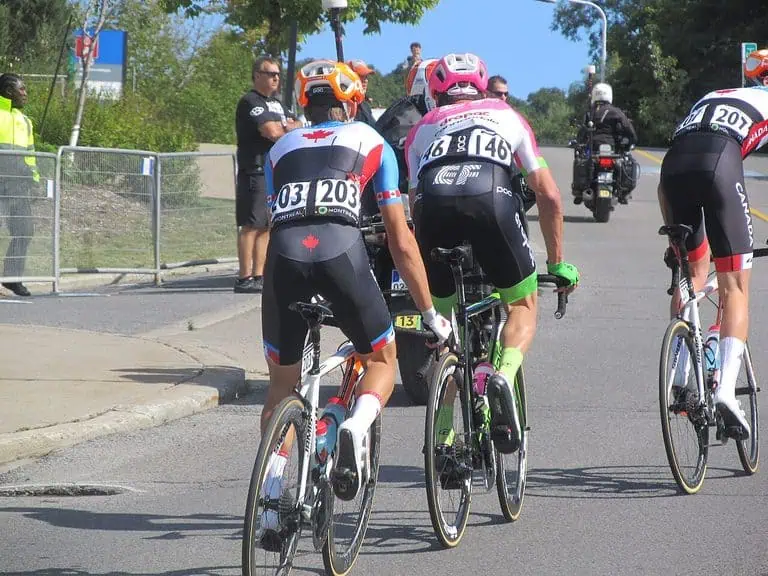
At the Road World Championships there are no trade teams. Riders leave their professional squads behind and assemble into temporary national squads, which means a Lidl-Trek rider becomes Belgian, French, Italian or British for the week. The jerseys change. The helmets, shoes and glasses usually change, because national federations have their own clothing deals.
The bikes don’t.
Because national teams are assembled from riders spread across a dozen different trade teams, nobody switches frames for one weekend of racing — and no rider would want to. Mathieu van der Poel won the 2023 world title on the same Canyon Aeroad he rode all season in the WorldTour, while his Dutch teammates lined up on whatever their own trade teams supplied.
The result is a peloton that looks wrong in the best possible way: seven riders in identical national kit, on seven completely different bikes, often in one-off paint schemes the sponsor has commissioned specially for the occasion.
What the Montreal course actually demands
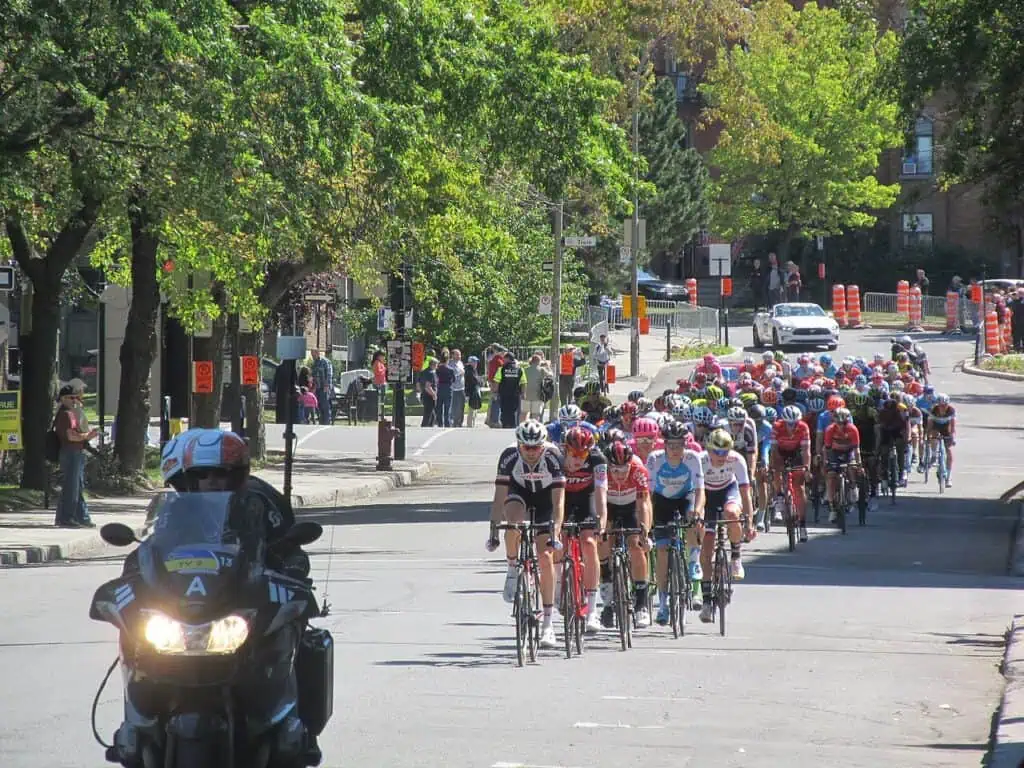
The road races are built on the Grand Prix Cycliste de Montréal circuit, and it is not a climber’s course in the Alpine sense — it’s an attrition course.
The riders face Camillien-Houde Road, 2.3 km at an average of 6.2%, plus the Polytechnique hill with sections steeper than 11%, before the false flat on Avenue du Parc that serves as the shared finishing straight for all 13 events. The elite men cover roughly 3,808 metres of climbing across about 273.7 km; the women climb about 2,570 metres over 180.4 km. Both elite road races start in Brossard, roll through the Montérégie, cross the Samuel De Champlain Bridge, and then hit twelve laps of the Mount Royal circuit for the men.
That profile sits right in the awkward middle. It’s too lumpy for a pure aero sled and nowhere near steep enough to justify a climbing bike. Expect most of the favourites on their aero all-rounders — which is exactly the trend that has taken over the peloton anyway. Because the UCI’s frame rules pushed brands to make aero frames lighter, many aero bikes now sit close to the 6.8 kg minimum, and riders like Pogačar and Vingegaard increasingly stay on them even in the high mountains.
The men’s contenders, bike by bike
Remco Evenepoel (Belgium) — Specialized S-Works Tarmac SL9. Red Bull-BORA-hansgrohe run the new Tarmac SL9 with SRAM Red AXS, Roval wheels and Specialized tyres, plus the Shiv for time trials. He is the rider the race has to organise itself around, and the only one here who can realistically win both the time trial and the road race.
Wout van Aert (Belgium) — Cervélo S5 or R5. Visma-Lease a Bike have the S5 aero bike, the lighter R5, the Soloist and the P5 for TTs, all on SRAM Red AXS with Reserve wheels. Belgium’s tactical luxury is having two winning options; their problem is deciding which one.
Mathieu van der Poel (Netherlands) — Canyon Aeroad CFR. Alpecin-Premier Tech continue their long Canyon partnership, running Shimano Dura-Ace, Shimano wheels and Pirelli tyres, with the Ultimate CFR as the lightweight option. Twelve laps of Camillien-Houde is the one thing that can remove him.
Tom Pidcock (Great Britain) — Pinarello Dogma F. Q36.5 became Pinarello-Q36.5 for 2026, with the Italian brand doubling its presence in the men’s peloton. The team runs SRAM Red AXS with Zipp wheels and had a special-edition colourway for the Tour.
Isaac del Toro (Mexico) — Colnago Y1Rs or V5Rs. UAE Team Emirates-XRG have the Y1Rs, the V5Rs and the new TT2, on Shimano Dura-Ace with ENVE wheels. Del Toro’s Tour stage-winning V5Rs was reported to sit almost exactly on the UCI weight limit. He has already won on this circuit — but Mexico has very little depth around him.
Paul Seixas (France) — Van Rysel RCR-F. Decathlon-CMA CGM race the RCR-F and RCR-R with SRAM Red AXS and Swiss Side wheels. Decathlon’s in-house brand winning a rainbow jersey would be one of the stranger sentences in modern cycling.
The Lidl-Trek bloc — Trek Madone SLR. Juan Ayuso rides for Spain, Mads Pedersen and Mattias Skjelmose for Denmark, Quinn Simmons for the USA, Giulio Ciccone for Italy. All of them will be on the Madone SLR with SRAM Red AXS and Bontrager wheels. Five nations, one frame.
Richard Carapaz (Ecuador) — Cannondale SuperSix Evo Lab71. EF Education-EasyPost switched from Shimano to SRAM this season, running Vision wheels and Vittoria tyres.
Filippo Ganna (Italy) — Pinarello Dogma F and Bolide F. Netcompany-Ineos moved to Scope Artech wheels for 2026 after years on Shimano. Ganna is here for the flat time trial more than the road race.
Enric Mas (Spain) — Canyon Aeroad CFR. Movistar pair Canyon frames with SRAM Red AXS and Zipp wheels.
Michael Matthews (Australia) — Giant Propel Advanced SL. Jayco-AlUla run Giant frames with Cadex wheels and tyres and Shimano Dura-Ace.
The women’s contenders, bike by bike
Demi Vollering (Netherlands) — Specialized Tarmac SL9. FDJ United-SUEZ stay on Specialized for 2026, running Shimano with Roval wheels. She arrives in Montreal having won the 2026 Giro d’Italia Women and the Tour de France Femmes, chasing a first world title.
Marlen Reusser (Switzerland) — Canyon Aeroad CFR. Movistar’s women run Canyon frames with SRAM Red AXS and Zipp wheels, with the Speedmax for time trials. She starts the week in the rainbow jersey as defending time trial champion.
Magdeleine Vallières Mill (Canada) — Cannondale SuperSix Evo. EF Education-Oatly run Cannondale with SRAM and Vision wheels. She returns as defending road race world champion at a home World Championships. If there’s one image that will define this week, it’s the current rainbow jersey on a Canadian rider on Mount Royal.
Lotte Kopecky (Belgium) — Specialized Tarmac SL9. SD Worx-Protime run the SL9 and the Shiv with SRAM and Roval wheels. She’s chasing a third world title in four years.
Zoe Bäckstedt and Kasia Niewiadoma-Phinney — Canyon Aeroad CFR. Canyon//SRAM run the full SRAM catalogue including Zipp wheels, plus Ergon saddles.
Kim Le Court-Pienaar (Mauritius) — Specialized Tarmac SL9. AG Insurance-Soudal are on Specialized with Shimano Dura-Ace and Roval wheels, with some older SL8 frames still in the fleet.
The time trials: a flat course, and a 65mm problem
Both elite time trials run on Sunday 20 September over the same 39.2 km course with just 220 metres of climbing, starting on Avenue du Parc. That’s a proper power course — it runs through Old Montreal, along the Saint Lawrence, through the Circuit Gilles-Villeneuve and back over the Concorde Bridge.
Which makes the TT bikes worth watching more than the road bikes: Evenepoel’s Shiv, Ganna’s Bolide F, van der Poel’s Speedmax CFR, Reusser’s Speedmax, the Trek Speed Concept SLR, and UAE’s new Colnago TT2. Colnago cut 550 g from the TT2 frameset, bringing a complete build close to the 6.8 kg limit.
One rule change shapes everything on the aero side this year. The UCI has capped rim depth at 65 mm, and with a possible hookless ban still hanging over the sport, wheel brands have hedged by building new rims with hooks or mini-hooks. Evenepoel has won every elite Worlds time trial since 2023 and beat Pogačar by 28 seconds in the Tour’s only individual time trial this summer — the flat Montreal course theoretically suits Ganna and the bigger specialists better, but it doesn’t expose an obvious weakness.
Key dates
- Sunday 20 September — Elite women’s ITT, 09:00; elite men’s ITT, 12:45
- Saturday 26 September — Elite women’s road race, 180.4 km from Brossard
- Sunday 27 September — Elite men’s road race, roughly 273 km from Brossard
All 13 races finish on Avenue du Parc at the foot of Mont Royal, and every one is free to watch from the roadside.
Sources
Race, course and start lists
- 2026 UCI Road World Championships — Wikipedia: https://en.wikipedia.org/wiki/2026_UCI_Road_World_Championships
- UCI — Race routes, favourites and start list: https://www.uci.org/article/uci-road-world-championships-race-routes-favourites-and-start-list/4MKBR9K8mEQhzx18UfO1Qx
- Tourisme Montréal — UCI Road World Championships Montréal 2026 (climb gradients, course detail): https://meet.mtl.org/en/blog/UCI-world-road-cycling
- Cycling Canada — Montréal to host the 2026 UCI Road World Championships: https://cyclingcanada.ca/news/montreal-to-host-the-2026-uci-road-world-championships/
- Milesopedia — Where to stay, what to do, how to watch: https://milesopedia.com/en/guide/experiences/montreal-uci-road-cycling-championships/
- Oberson — A Spectator’s Guide to the 2026 UCI Road World Championships: https://oberson.com/en/blogs/events/spectator-guide-uci-world-championships-2026