Your Ride Home Goes Dark on November 1. Here’s What the Research Actually Says About Being Seen.
Daylight saving time ends at 2:00 a.m. on Sunday, November 1. On Monday, an evening commute that was in daylight is in the dark — and the federal crash data says that’s the most dangerous three-hour window of the year for cyclists.
Nothing about your route changes. Your fitness doesn’t change. The only thing that changes is that the sun now sets roughly an hour earlier, and the ride you’ve done four hundred times happens in conditions you haven’t ridden in since March.
Here’s what the data says about that, and what the visibility research actually supports — including the part that complicates the standard advice.
The numbers
According to NHTSA’s most recent published figures, more cyclist fatalities occur in the dark than in daylight: 52% dark, 44% daylight, 3% at dusk, and 1% at dawn.
That’s not a one-year fluke. It’s a trend. In 2015, daylight and dark were tied at 47% each. By 2018 dark had reached 50%, and it has sat at or above 51% every year since — 52% in 2021, 51% in 2022, 53% in 2023, 52% in 2024. Riding in the dark has become more dangerous relative to riding in daylight, not less, even as bike lights have gotten dramatically better and cheaper.
The time-of-day breakdown is sharper still. Across every season, the 6:00 to 8:59 p.m. window accounts for the largest share of cyclist deaths. In the fall months specifically, more than a quarter of the year’s cyclist fatalities land in those three hours. In winter it’s similar.
And these aren’t remote rural roads. Roughly four in five cyclist fatalities happen in urban areas, and about 62% occur somewhere other than an intersection — which is to say, on ordinary stretches of ordinary streets.
The first two weeks are the worst part
There’s a reason to care specifically about early November rather than winter generally: nobody has adjusted yet. Drivers who have spent seven months doing the evening commute in daylight are suddenly doing it in the dark, on the same autopilot, at the same speed. Their expectations haven’t updated. Neither have yours.
If you’re going to be deliberate about visibility for two weeks a year, make it the two weeks after the clocks change.
What the research says works
The visibility literature is more specific than “wear something bright,” and some of its findings run against instinct.
Active beats passive, by a lot. Studies comparing visibility treatments consistently find that bike-mounted lights make cyclists more conspicuous than retroreflective vests or reflective bands. A light emits; a reflector only returns light that’s already aimed at it. If a driver’s headlights aren’t pointed at you yet — on a curve, at an angle, at an intersection — a reflector does nothing.
Flashing beats steady, and the rate matters. Flashing headlamps and tail lamps were the most conspicuous treatments in testing during both day and night. The optimal rate differs by condition: faster flashing headlamps, around 6.7 Hz, produced better detection distances and rates during the day, while a more moderate rate around 3.4 Hz worked better at night. Practically, that means using your lights’ day-flash mode in daylight and a calmer flash or steady mode after dark — most modern lights have both, and most riders never switch.
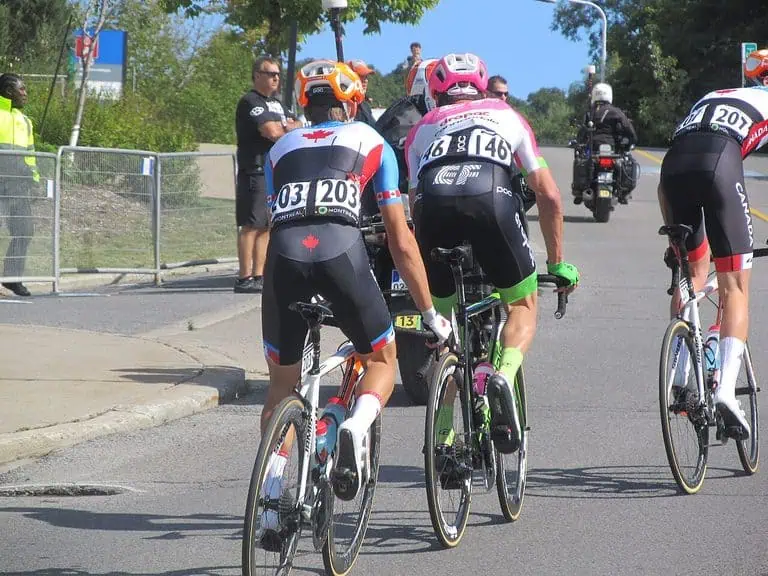
Put reflective material on your ankles, not your chest. This is the single most counterintuitive finding, and it’s very well supported. Retroreflective strips positioned on the knees and ankles let drivers recognize a cyclist significantly earlier than a reflective vest does. The reason is biological motion: the rhythmic up-and-down pedaling pattern is something human perception identifies instantly and uniquely as a person. A static reflective panel on your back is just a bright shape. Moving ankles are unmistakably a cyclist.
The benefit shows up with strips on the ankles alone, which means reflective socks or shoe detailing is a legitimate solution rather than a compromise. And a 2020 study found the biomotion advantage exists in daylight too, not only at night.
Consider a helmet-mounted light. Research from 2022 found drivers recognized cyclists earlier when the headlight was mounted on the helmet rather than the handlebars — and that the leg-mounted reflective strips were most effective in combination with a helmet-mounted light. A helmet light also points where you look, which matters at intersections where you want a driver to see you looking at them.
Use more than one rear light, at different heights. Multiple rear lights — seatpost, seatstay, helmet, bag — help drivers judge distance and closing speed, which a single point of light doesn’t.
The caveat nobody includes
Here’s the part that separates honest coverage from gear marketing.
A Cochrane review of visibility aids found 42 studies measuring whether drivers detected people with or without visibility equipment — and no studies that compared actual crash numbers. The evidence base is about detection distance, not about deaths prevented. Those are related, but they aren’t the same claim.
More awkwardly, a 2014 Canadian case-control study reported increased odds of collision for cyclists using fluorescent clothing and lights at night, and a 2012 British study found a non-significant increase in crash odds for users of reflective aids. Taken at face value, that sounds like high-vis gear makes things worse.
It almost certainly doesn’t. The most likely explanation is confounding: riders who kit themselves out in reflective gear tend to be the ones riding in the most dangerous conditions — darker routes, worse weather, heavier traffic, longer distances. The gear correlates with the risk because the risk is why they bought the gear.
But the honest version of the advice is this: visibility equipment reliably makes you easier to see, and that is worth doing. It does not make you safe, and no amount of it substitutes for route choice, lane position, and riding as though you haven’t been seen. A driver who is looking at their phone will not see a 1,000-lumen light.
The setup
If you’re starting from nothing, this is the order to buy in:
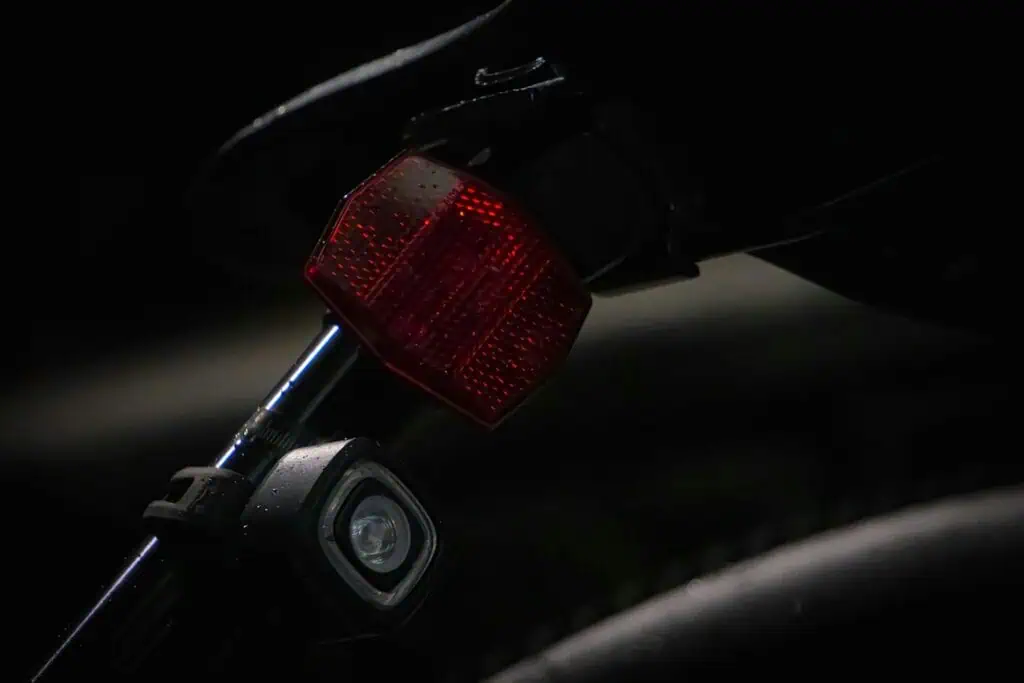
- A rear light with a daytime flash mode. The highest-value single item. Rear-end and overtaking collisions on non-intersection stretches are where the fatalities concentrate.
- A front light bright enough to see with, not just be seen. Two different jobs. A 200-lumen “be seen” light is useless on an unlit path where you also need to spot potholes.
- Reflective ankle bands or socks. Cheap, and the research support is stronger than for anything else you’ll buy.
- A second rear light at a different height. Helmet or bag.
- A spare set of batteries or a charged backup. Most dark-commute failures are dead lights, not absent ones.
Two habits that cost nothing: charge lights on a schedule rather than when they die, and switch flash modes when conditions change rather than leaving them in whatever mode they were in last March.
Before Sunday, November 1
Check that every light you own still holds a charge. Fit the ankle bands now, while you’ll remember. And ride your normal evening route once in the dark before you have to — the pothole you’ve been steering around by memory since spring is genuinely hard to see at 5:30 p.m. in November.
Arizona and Hawaii don’t observe daylight saving time, so if you’re in Phoenix or Honolulu none of the date matters to you. The lights still do.